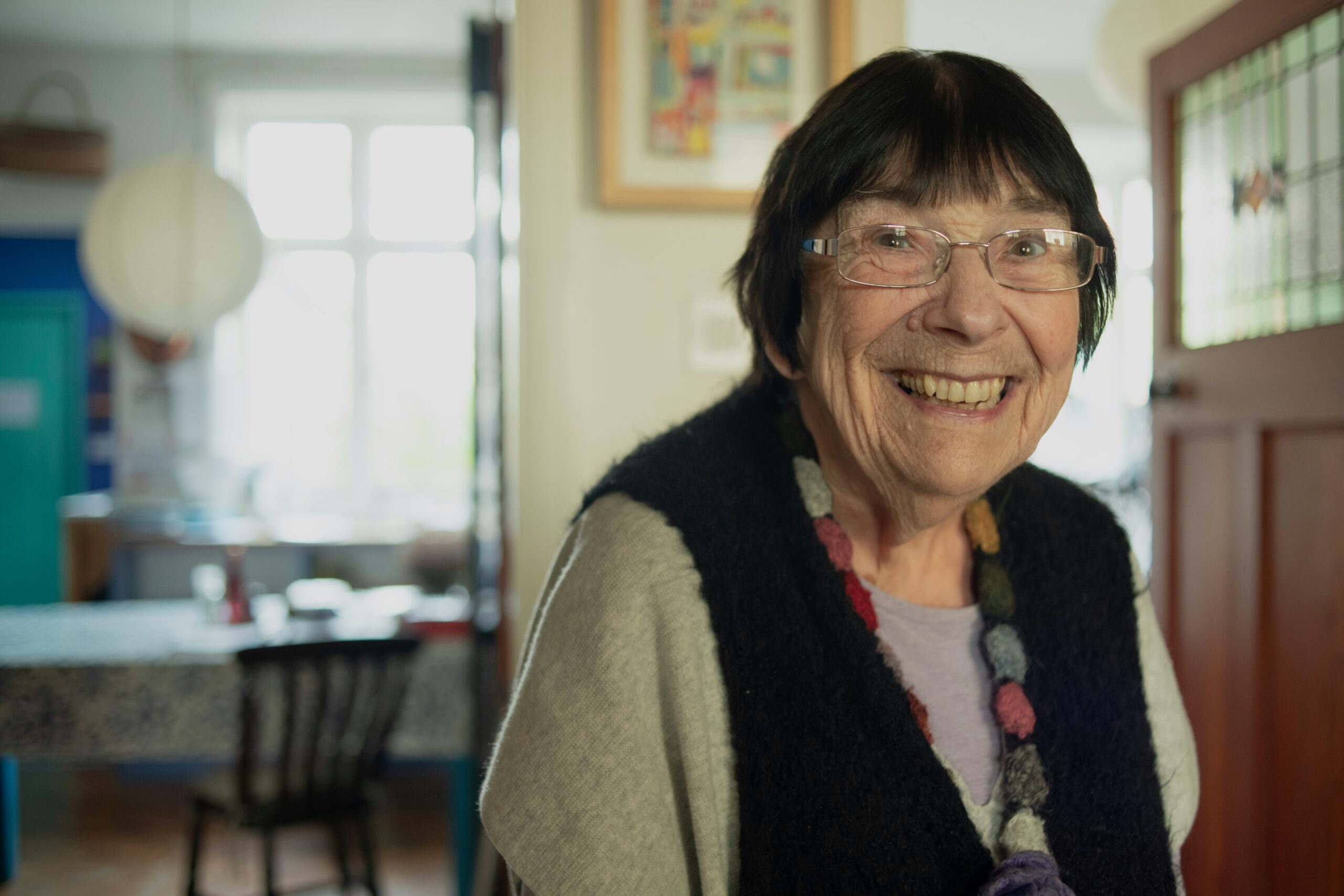
Mary Lloyd Jones is not simply one of Wales’s most respected artists. She is one of the defining visual voices of modern Wales. Born in 1934 in Ceredigion, and trained at Cardiff College of Art, she has exhibited widely since the mid 1960s and has become one of the country’s most admired and enduring visual artists. Her richly layered works, rooted in landscape, language and memory, draw on the marks of early civilisation, ogham inscriptions and bardic alphabets, weaving together history and place with unmistakable authority. Now in her tenth decade, and determinedly strong despite significant challenges to her health, Mary remains a creative force. Over the years she has travelled and worked as an artist in Scotland, Ireland, the United States, India, Italy, Spain and France. Yet it is the landscape of Ceredigion, and the deep time embedded within it, that has always remained central to her work.
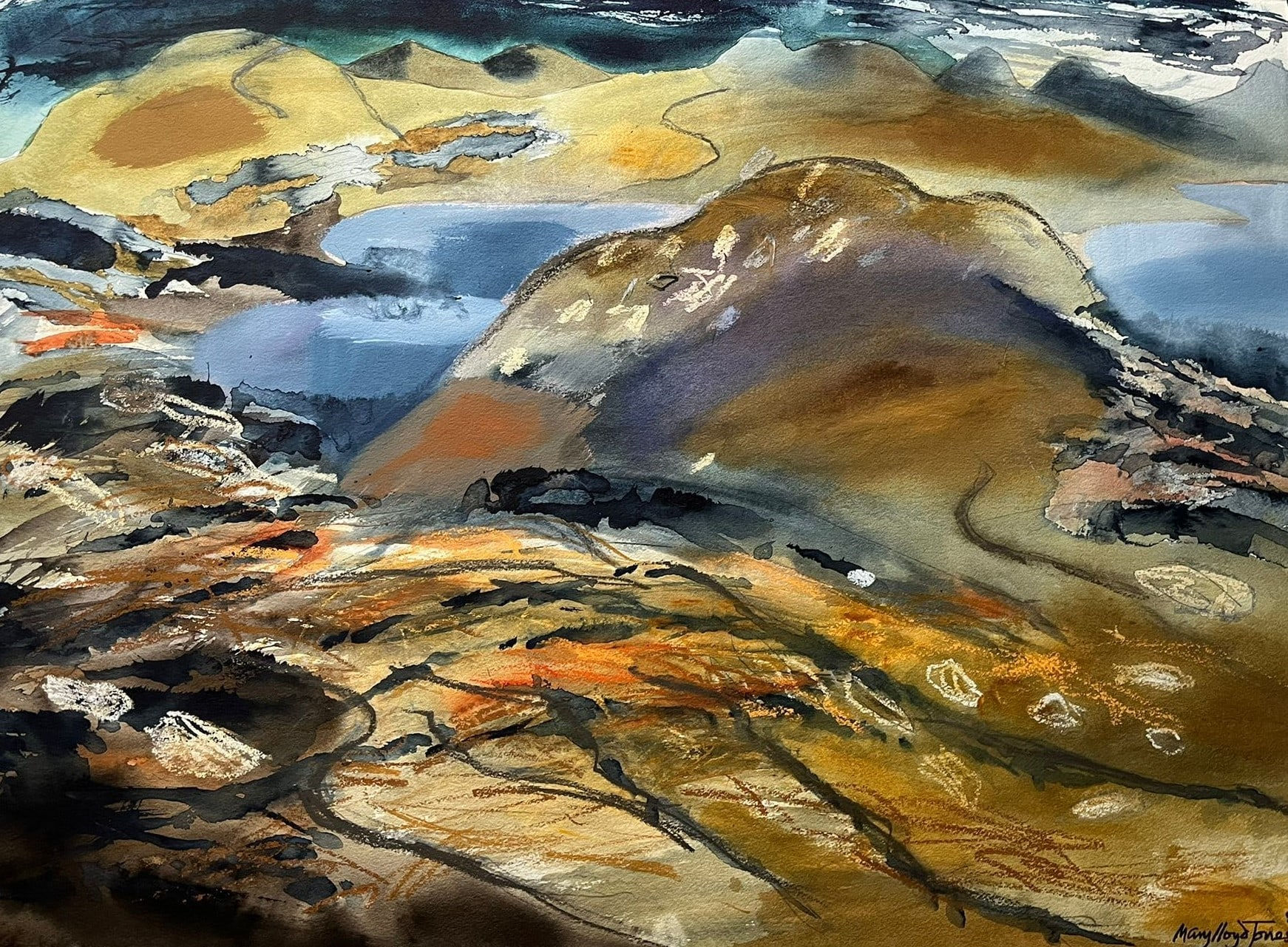
Cwm Rheidol 5, 1987 by Mary Lloyd Jones
Courtesy of Celf Gallery
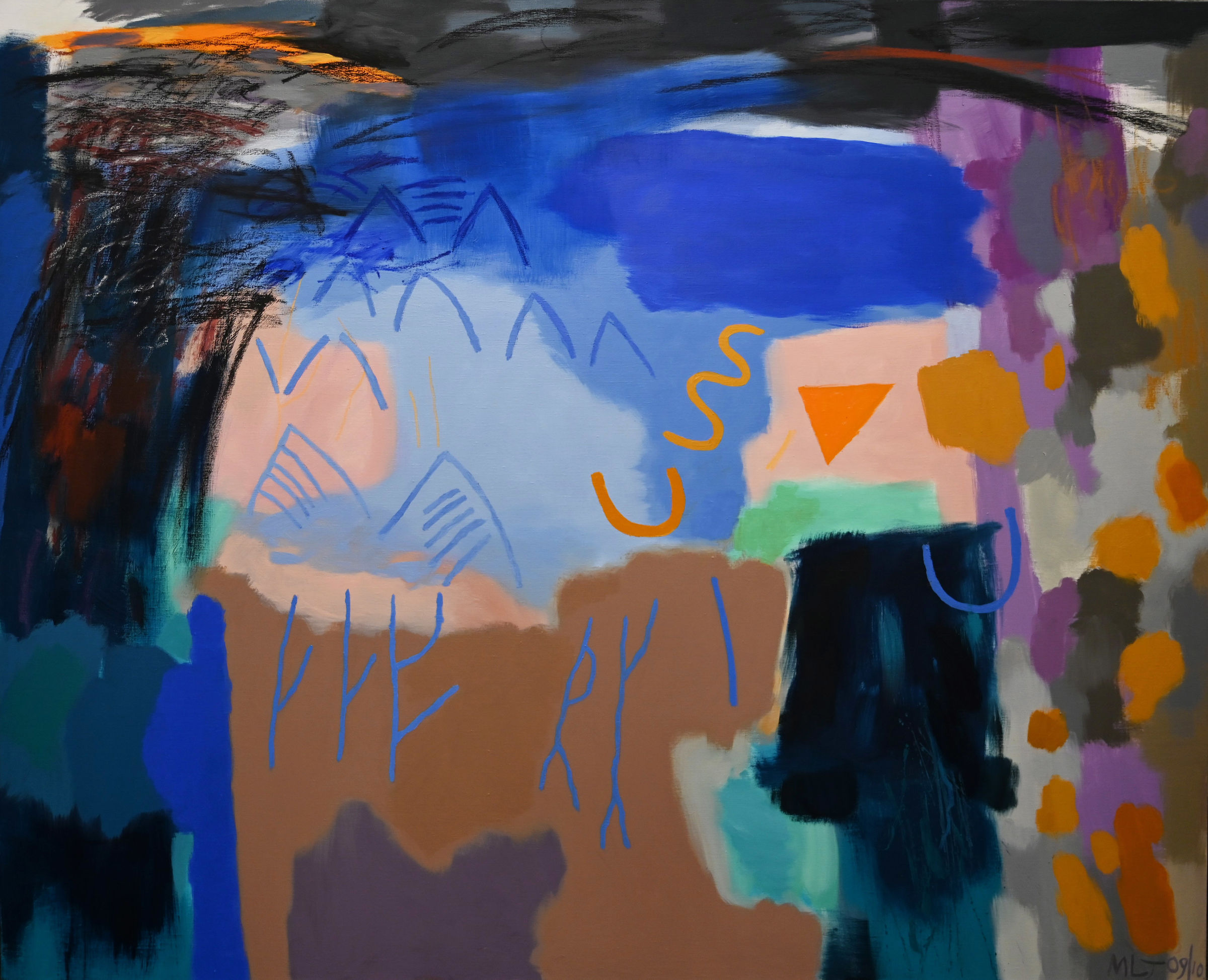
Hen Iaith Old Language, 2009 – 2010 by Mary Lloyd Jones
Courtesy of Celf Gallery
For our spring 2026 Spirit of Wales theme, there could be no more fitting figure for Olion, our series celebrating those who leave a mark on Wales. Mary Lloyd Jones has done precisely that — not loudly, not fleetingly, but enduringly. As she has said of her own practice: “My aim is that my work should reflect my identity, my relationship with the land, an awareness of history, and the treasure of our literary and oral traditions.”
Mary’s story begins in Pontarfynach — Devil’s Bridge — in Ceredigion, a place that continues to shape her imagination.
“When I was growing up in Pontarfynach, I spent a lot of time playing on my own, and I was free to go wandering all over the area. There were no cars. I knew the area very well.”
That early freedom left its imprint: “‘The Stag’, the man-made scarring of the landscape in Cwm Rheidol, has appeared many times in my work. I would see it every school day, travelling up and down to Aberystwyth on the bus.”
Her father had been a weaver when he was younger, later becoming a road mender, walking daily between Devil’s Bridge and Cwmystwyth. One memory remains especially vivid for Mary: “I remember visiting the weaving mill near the railway line on the Mynach river when I was very young. I went in with my father and I can remember being fascinated by bits of coloured yarn still left on the floor.” And the idea of threads of landscape, labour and colour have never left her.
From the beginning, she responded to the world around her by drawing. “I do remember doing early drawings of my family — my brother asleep, my mother, and aunts and uncles.” When she encounters those early sketches now, she says, “I do enjoy seeing the pieces again and it gives me confirmation that I should carry on. Seeing them gives me new ideas and it is all part of the creative process.”
As a student, Gwen John was one of the only Welsh artists she was aware of. Later, while teaching at Swansea College of Art, she met Glenys Cour, who became “an influential and inspiring force.” Teaching art history broadened her perspective further, and travelling to Europe — to France and Italy in particular — to see original works in galleries and museums was “very important to my development as an artist.”
Travel extended far beyond Europe. To China, India, Russia, and New Mexico. Each journey widening her understanding of culture, landscape and mark-making.
Yet despite that global exposure, Mary has always deliberately looked backwards in time for inspiration. “I have always purposefully looked to history and prehistory for my source of inspiration.” She also remains faithful to the paintbrush. “I have not made any work using new technology as opposed to the paintbrush,” although she has worked with the support of the National Library of Wales map department, where digital prints were created using maps, text and her paintings.
History and language are central to her practice. “History is important to me. I am interested in Welsh and other languages and their links to the landscape — languages that have been here a long time.”
Mary’s commitment to art has always extended beyond her own studio in mid-Wales. Over her career she has taught children in schools, students in colleges, adult evening classes and workshops. “I do believe strongly that art education in schools is the best way to offer children the experiences of making and being creative. Skills that they can always come back to as an adult.”
When she began, Welsh women artists were not well supported or widely represented. That, she says, has significantly changed. There are now galleries, art centres, the National Museum of Wales and the National Library of Wales — places where art is taken seriously and where people can take part in learning and creative practice. Early support from David Tinker and the 56 Group was important to her, followed later by Martin Tinney in Cardiff.
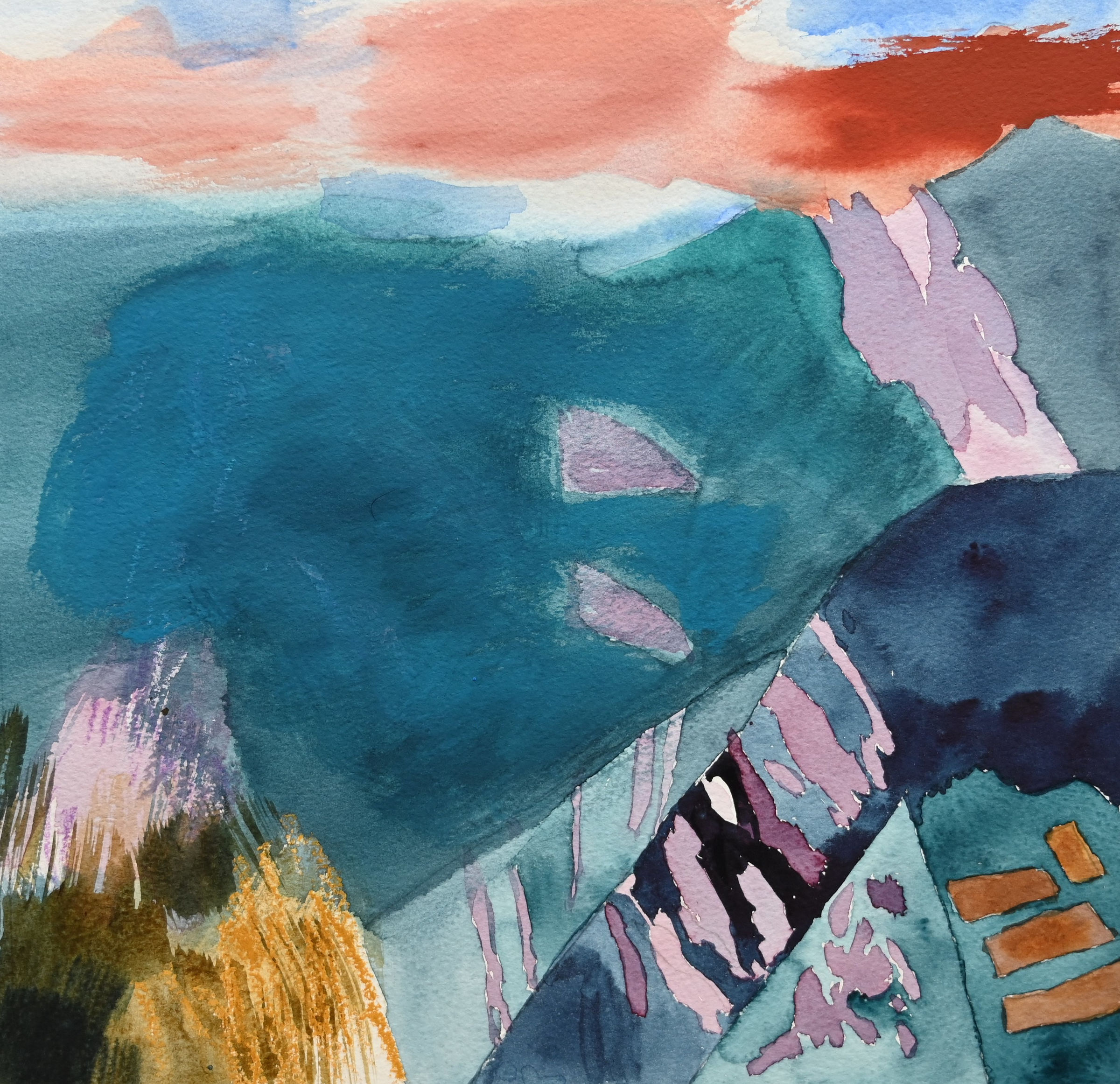
Olion Diwydiannol Industrial Remains, c. 2000 by Mary Lloyd Jones
Courtesy of Celf Gallery
However, not all inspiration comes from the landscape, it comes from many directions. She has read avidly all her life, beginning with the Encyclopaedia Britannica — the only book in the house when she was growing up. Her shelves are filled with art books and exhibition catalogues, from Matisse and Gauguin, who fascinated her as a student, to ancient history and early civilisations, to women artists addressing feminist issues. She was a subscriber to feminist publications such as Spare Rib, and she recently rediscovered the 1987 London exhibition catalogue for The Dinner Party — an installation artwork by American feminist artist Judy Chicago, where 39 elaborate place settings on a triangular table represent 39 mythical and historical famous women.
Music has always filled her studio. Her late daughter, Sianed, was a musician and singer, and Mary followed her career closely. She greatly admires the work of Glenys Cour and Roger Cecil, whose pieces hang on her wall.
“I can remember being fascinated by bits of coloured yarn still
left on the floor.”
Recent years have tested her resilience. After her second stroke, she left hospital and set up a painting table in her downstairs bedroom, where she now works on a smaller scale. After the second stroke, “I was determined to try and see how I got on.” While still being able to get outside to draw — she continues to visit familiar places such as Cwm Rheidol and Ysbyty Ystwyth several times a week — she relies more heavily now on photographs, and on old work stored in the plan chest. “I am enjoying meeting the work again. Getting back to work was important to me, and it is important to enjoy what you’re doing.”
Importantly for Mary, when many people would be looking to wind down, she says there is little separation between her work and rest. “Looking at things around me, and actively working on my own work. This is the way I always relax or switch off.”
With the recent news of Aberystwyth becoming Wales' very first UNESCO City of Literature, she is very keen to be involved. This designation will boost the creative economy, support local writers, promote diversity, and connect the town with an international network of UNESCO Cities of Literature to share expertise.
To close the interview, her advice to her younger self is direct: “devote time to your own work as an artist, but look to other artists and art forms for inspiration.” And when asked what kind of mark she wishes to leave on Wales, she answers with characteristic clarity: “My future is now. I cannot comment on the future past my time.”
What readers learn from Mary Lloyd Jones is not simply how an artist works, but how a life in art is sustained: by attention to place, by respect for history, by curiosity across disciplines, by community, and by quiet determination in the face of challenge. Her mark on Wales is not only in galleries and collections. It is in the way she has shown that landscape, language and memory can be carried forward, one brushstroke at a time.
See more of Mary's work online at
www.marylloydjones.co.uk, www.celfgallery.com or www.midwalesarts.org.
This conversation with Mary Lloyd Jones is a part of our series called Olion, the Welsh word for traces and mark-making — a series of conversations with some of Wales’ most inspiring women. We explore the marks they’re leaving on the world around them, the traditions and ideas they’re carrying forward, and what matters most to them in this moment. Together, we reflect on the Wales they’re helping to shape and the legacy they hope to leave behind.